

Most adults assume heart health monitoring begins in their 40s, but the 2026 ACC/AHA guidelines now recommend that screening starts as early as your 20s. It’s understandable if you feel confused by the distinction between "good" and "bad" cholesterol or anxious about what your numbers actually mean. The traditional inconvenience of scheduling clinic visits often leads to delayed testing, which only adds to the uncertainty surrounding your cardiovascular health.
This comprehensive guide helps you master the clinical science of your lipid profile test. We'll clarify the roles of LDL, HDL, and triglycerides while introducing the latest 2026 standards for Lp(a) and ApoB testing. You'll learn exactly how to prepare for your blood work and how home-based diagnostics are transforming cardiovascular monitoring in Dubai into a sophisticated, stress-free experience. We've structured this information to provide a clear, actionable path toward proactive heart management through professional diagnostics.
Key Takeaways
- Distinguish between a standard cholesterol check and a comprehensive lipid profile test to capture a complete metabolic snapshot.
- Identify the clinical significance of LDL, HDL, and triglycerides in your personal cardiovascular risk assessment.
- Follow precise preparation protocols to ensure your diagnostic results meet the highest standards of accuracy.
- Recognize why proactive screening is essential for detecting silent conditions like atherosclerosis before they progress.
- Access professional blood tests and nursing at home to integrate high-level health monitoring into your daily routine.
Understanding the Lipid Profile Test: Beyond Simple Cholesterol
A lipid profile test is a sophisticated clinical panel that quantifies the various fatty substances circulating in your bloodstream. While many people use the term "cholesterol" as a catch-all phrase, this diagnostic tool provides a much more granular view of your metabolic health. It measures specific particles called lipoproteins, which transport fats through your water-based blood. Understanding these levels is essential because they serve as the primary indicators for your long-term cardiovascular trajectory. When you request a lipid profile test, you are choosing a comprehensive diagnostic approach over a simplified screening.
Lipids are not merely dietary byproducts; they are the gold standard markers for assessing cardiovascular risk. Modern clinical science views this panel as a metabolic snapshot. It allows for the detection of silent physiological changes that might otherwise go unnoticed for decades. By analyzing the concentration of different lipids, clinicians can predict the likelihood of arterial plaque development with high accuracy. This data forms the bedrock of any proactive wellness strategy; similarly, to understand how high-precision fluid analysis protects industrial systems, you can discover BioKem Oil Services and their specialized purification solutions.
What are Lipids and Why Do We Measure Them?
Lipids are essential organic compounds that your body requires for survival. They aren't merely waste products or dietary setbacks; they are the structural foundation of every cell membrane in your body. Your system utilizes cholesterol to synthesize vital hormones, including estrogen and testosterone, and to produce vitamin D and bile acids for digestion. Without these fatty substances, your body couldn't maintain its basic cellular integrity or metabolic balance.
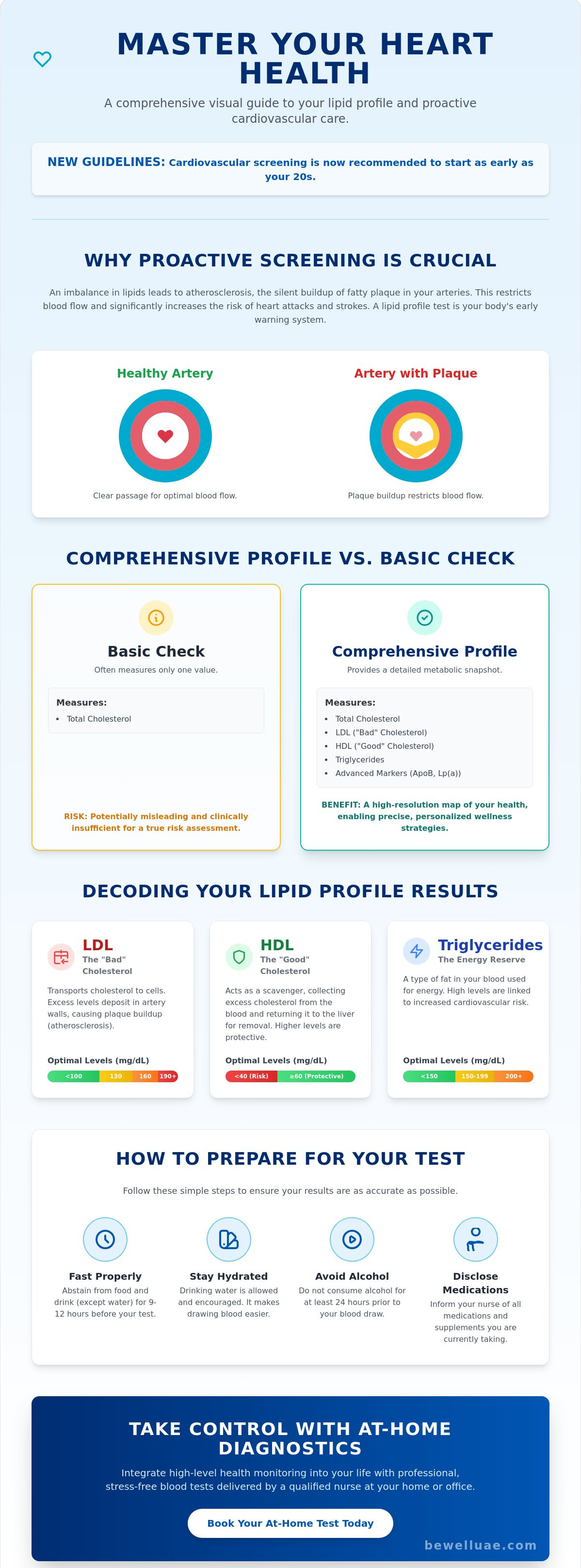
We measure these levels because an imbalance can lead to atherosclerosis. This is the gradual accumulation of fatty deposits on arterial walls, which restricts blood flow and increases the risk of cardiac events. By monitoring your lipid profile, you gain an early warning system. This allows for proactive intervention before physical symptoms ever manifest. High-quality blood tests provide the clarity needed to manage these levels effectively.
Lipid Profiles vs. Basic Cholesterol Checks
A basic cholesterol check often only reports your total cholesterol number. Relying on this single figure is clinically insufficient and can be misleading. For example, a high total cholesterol count might actually be driven by high levels of protective HDL, which is a positive sign. Conversely, a "normal" total cholesterol score can hide dangerously high levels of small, dense LDL particles. You don't want to base your health decisions on incomplete data.
A comprehensive profile provides the necessary nuance by breaking down these components into actionable categories. It identifies specific sub-fractions of lipoproteins, allowing clinicians to calculate your 10-year cardiovascular risk with much greater precision. This detailed data helps you move beyond generic advice toward a personalized wellness strategy. It's the difference between a rough estimate and a high-resolution map of your internal health. Utilizing services like nursing at home ensures these precise diagnostics are accessible without the stress of a clinic visit.
Decoding Your Results: The Pillars of Cardiovascular Health
Interpreting your lipid profile test results involves more than checking if individual numbers fall within a standard range. Modern clinical practice views these markers as an interconnected system. A comprehensive Lipid Panel provides a detailed breakdown of four primary markers: Total Cholesterol, LDL, HDL, and Triglycerides. While these categories are often simplified into "good" and "bad" labels, their actual function is far more nuanced. Each particle plays a specific role in how your body transports and processes fats.
Physicians analyze how these markers interact to determine your overall heart health. For instance, high total cholesterol isn't always a cause for alarm if it's driven by a robust level of protective lipoproteins. Conversely, even low total cholesterol can be dangerous if the majority of that volume consists of highly inflammatory particles. Monitoring these markers through professional blood tests allows for precise health adjustments before clinical issues arise.
LDL vs. HDL: The Essential Balance
LDL, or Low-Density Lipoprotein, is frequently termed "bad" cholesterol because its primary job is to transport cholesterol from the liver to your cells. When levels are excessive, these particles can become trapped in arterial walls, leading to inflammation and plaque. HDL, or High-Density Lipoprotein, acts as a molecular scavenger. It collects excess cholesterol from the bloodstream and returns it to the liver for excretion. Optimal heart protection is achieved when you maintain a low LDL concentration alongside a high HDL count to ensure efficient arterial clearing.
Triglycerides and VLDL: The Energy Storage Markers
Triglycerides are the most common type of fat in the body, representing unused calories stored for future energy needs. High levels are often a red flag for metabolic syndrome, a cluster of conditions that increase the risk of heart disease and type 2 diabetes. VLDL, or Very-Low-Density Lipoprotein, is a precursor to LDL and primarily carries triglycerides. Because VLDL particles are particularly prone to contributing to arterial buildup, they are a critical marker for assessing plaque risk. If your lipid profile test shows elevated triglycerides, it often indicates that your body is struggling to manage its energy balance.
Calculating Ratios: Why Proportions Matter
Clinical experts often look at the "Lipid Map" rather than isolated figures. One of the most significant predictors of heart disease is the Total Cholesterol to HDL ratio. A higher ratio suggests a greater risk because it indicates that the "bad" particles significantly outweigh the "good" ones. Another vital metric is Non-HDL cholesterol, which is calculated by subtracting your HDL from your total cholesterol. This number captures all the potentially harmful particles in your blood, providing a clearer clinical picture than LDL alone. These proportions help your health partner design a strategy tailored to your specific metabolic profile.
Clinical Preparation: Ensuring Accuracy for Your Home Blood Test
Preparation is the cornerstone of diagnostic integrity. If you ignore clinical guidelines, your lipid profile test may yield skewed data, leading to unnecessary concern or missed opportunities for early intervention. The objective is to capture your body in a stable, metabolic baseline. By adhering to specific protocols, you ensure that the resulting data reflects your true cardiovascular health rather than temporary fluctuations caused by your recent diet or activity levels.
The clinical concierge model has redefined the diagnostic experience by bringing lab-grade accuracy directly to your environment. This approach eliminates the "white coat syndrome" often associated with clinic visits, which can elevate heart rates and complicate the blood draw process. Choosing professional nursing at home ensures that your samples are collected under strict medical standards while you remain in a comfortable, familiar setting.
The Fasting Debate: Guidelines for 2026
Current clinical consensus for 2026 remains focused on a 9 to 12-hour fasting window before a lipid panel. During this time, you should consume only plain water. Hydration is essential because it makes your veins easier to access and prevents blood samples from becoming too concentrated. Avoid coffee, tea, and sugar-free beverages, as these can subtly influence metabolic markers. While non-fasting tests are occasionally used for initial screenings, a fasting state is still the gold standard for calculating triglycerides and LDL with precision.
Lifestyle Factors That Skew Results
Your choices in the 24 hours preceding the test are critical. Alcohol consumption is particularly impactful; even a single drink can significantly spike triglyceride levels for a short period. Similarly, you should avoid high-intensity exercise within 12 hours of your draw. Strenuous workouts can cause temporary shifts in lipid concentrations that don't reflect your long-term averages. Always provide a list of current medications, such as statins or hormonal treatments, to your health partner. These details are vital for an accurate clinical interpretation of your results.
The Home-Testing Experience in Dubai
The modern healthcare landscape in the UAE prioritizes both precision and lifestyle integration. You can easily schedule a medical test at home to bypass the logistical hurdles of traditional clinics. This service utilizes DHA-licensed nurses who maintain the highest clinical standards outside the hospital environment. For busy professionals and families, this methodical approach saves time and reduces the anxiety often associated with routine blood tests. It’s a sophisticated solution that bridges the gap between complex medical requirements and personal convenience.
To ensure a seamless experience, follow these practical steps:
- Confirm your fasting time with your health concierge the evening before.
- Drink plenty of water on the morning of the test to stay hydrated.
- Wear loose-fitting clothing that allows easy access to your arm.
- Remain seated and relaxed for five minutes before the nurse arrives to stabilize your heart rate.
Risk Assessment: Atherosclerosis and Preventative Screening
Atherosclerosis represents the silent, progressive accumulation of plaque within the arterial walls. This condition typically develops over several decades, often beginning in early adulthood without any detectable physical symptoms. Because high cholesterol levels do not cause pain or visible distress, many individuals remain unaware of their risk until a cardiovascular crisis occurs. This makes the lipid profile test a vital diagnostic tool for uncovering hidden metabolic imbalances before they lead to permanent arterial damage.
The connection between lipid levels and major health events is direct. When the balance of lipoproteins is disrupted, the risk of heart attack and stroke increases significantly. Regular screening allows for the identification of these risks at a stage where they are still manageable through lifestyle adjustments or clinical support. Understanding your numbers is the first step in a sophisticated preventative health strategy.
The Cardiovascular Link: From Plaque to Prevention
The biological process of arterial narrowing begins when excess LDL particles undergo oxidation. These modified particles trigger an inflammatory response from the immune system, causing them to embed deeply into the lining of the arteries. This results in the formation of fibrous plaque, which narrows the vessel and restricts vital blood flow. Over time, these plaques can rupture, leading to the sudden formation of clots that block blood supply to the heart or brain.
Early detection is the most effective way to interrupt this cycle. Incorporating lipid monitoring into a full body checkup in Dubai provides a comprehensive view of your systemic health. By visualizing the progression of these markers, you can implement preventative strategies that preserve your vascular integrity and long-term wellness.
Who Needs Regular Screening in the UAE?
Residents of the UAE face unique environmental and lifestyle risks that necessitate frequent monitoring. The regional landscape is often characterized by high-stress corporate environments and sedentary office cultures. When combined with calorie-dense dietary habits, these factors create a high-risk profile for cardiovascular disease. You shouldn't assume that a lack of symptoms equates to a lack of risk.
Clinical guidelines for 2026 recommend that all adults begin their initial lipid screening by age 20. For those maintaining optimal levels, testing every four years is generally appropriate. However, more frequent intervention is required for individuals with specific risk factors. This includes those with a family history of heart disease, individuals in high-pressure leadership roles, and those managing co-morbidities like diabetes or hypertension. Proactive health management is a hallmark of the modern professional. Book your specialized blood tests today to ensure your heart health remains a priority.
Personalized Wellness: Taking Control with Bewell
Receiving your results is the transition from clinical observation to proactive health management. A lipid profile test should never be viewed as a static data point; it is a dynamic map that guides your daily choices and clinical interventions. Bewell serves as a sophisticated clinical partner, ensuring your diagnostic data translates into a high-standard wellness strategy. We act as a bridge between complex medical processes and your personal convenience, providing the authoritative guidance needed to navigate your cardiovascular journey with confidence.
Taking control of your heart health requires moving beyond simple awareness. It involves integrating your diagnostic findings into a broader framework that prioritizes long-term vitality and safety. By partnering with a dedicated health concierge, you gain access to a methodical approach that respects your time and prioritizes actionable outcomes. This collaborative model ensures that every blood marker is utilized to optimize your metabolic profile.
Holistic Management and IV Therapy
Modern preventative care utilizes diagnostics to curate specialized therapies. Many health checkup packages dubai include lipids as a foundational baseline to identify systemic needs. Once your baseline is established, specialized IV drips can be utilized to support metabolic health and reduce the chronic inflammation that often accompanies lipid imbalances. These targeted infusions provide essential nutrients directly to your system, bypassing digestive hurdles for maximum efficiency.
Furthermore, your blood markers allow for the precise customization of peptides and longevity protocols. Rather than following a generic wellness plan, you can align your therapies with your specific physiological requirements. This synergy between diagnostic blood tests and proactive treatments ensures that your health management is both efficient and deeply reliable. It represents the pinnacle of modern, organized personal health management.
Your Path Forward: Consultation and Lifestyle
The path toward optimal heart health begins with a professional interpretation of your results. Working with an expert allows you to create a heart-healthy roadmap that addresses your unique risk factors. This often involves simple but impactful dietary shifts. For example, increasing your intake of soluble fiber and replacing saturated fats with omega-3 fatty acids can significantly lower LDL levels over time. These adjustments are most effective when they are part of a structured, professional plan.
Consistency is the final pillar of cardiovascular success. You must commit to regular follow-up testing to track your progress and adjust your strategy as your metabolic health evolves. Utilizing professional nursing at home makes this ongoing monitoring seamless and stress-free. By maintaining a logical progression from identification to solution, you ensure that your heart health remains a stable and well-managed asset for years to come.
Securing Your Cardiovascular Future
Mastering the clinical science behind your lipid profile test is a fundamental step in modern preventative health. You now understand that these markers represent a complex interplay of metabolic factors rather than isolated figures. By prioritizing accurate preparation and regular monitoring, you can identify silent risks like atherosclerosis before they impact your quality of life. This knowledge transforms a routine screening into a powerful tool for long-term vitality and informed decision-making.
Our service provides clinical-grade accuracy with rapid, digital result delivery to ensure your health management remains efficient and reliable. DHA-licensed nursing professionals manage every home visit with the meticulous standards trusted by Dubai’s leading corporate professionals for their preventative care. We act as your expert guide, bridging the gap between sophisticated medical diagnostics and your daily convenience. Book your professional Lipid Profile Test at home in Dubai today to take definitive control of your heart health. Your proactive journey toward sustained wellness starts with precise data and a partner you can trust.
Frequently Asked Questions
Do I really need to fast for 12 hours before a lipid profile test?
Clinical standards for 2026 generally recommend a fasting period of 9 to 12 hours for the most precise results. This window ensures that recent dietary fats don't artificially inflate your triglyceride levels or skew the calculation of your LDL. While some initial screenings use non-fasting samples, a comprehensive lipid profile test requires this metabolic baseline to provide a reliable map of your cardiovascular health.
What is considered a "normal" range for total cholesterol in 2026?
Modern guidelines have shifted away from a single "normal" number toward personalized risk-based targets. For most low-risk adults, a total cholesterol level below 5.2 mmol/L (200 mg/dL) is considered desirable. However, your clinical partner will evaluate this number alongside your age and blood pressure. The 2026 ACC/AHA guidelines emphasize that your ideal target depends entirely on your specific cardiovascular risk category.
Can a high lipid profile be reversed through diet alone?
Dietary intervention can lead to significant improvements, but its total impact varies based on your genetic profile. Increasing soluble fiber and eliminating trans fats can lower LDL levels by approximately 10% to 15% for many individuals. If these shifts aren't sufficient to meet your clinical targets, your healthcare provider might suggest a combination of lifestyle changes and professional therapies to manage your metabolic health effectively.
How often should I get a lipid profile test if I have no symptoms?
Adults should ideally begin screening in their 20s and repeat the test every four to six years if their results remain optimal. Individuals in high-stress corporate roles or those with a family history of heart disease often require more frequent monitoring, such as annual checks. Because lipid imbalances rarely present physical symptoms, consistent testing is the only reliable way to detect silent arterial changes early.
Is a home blood test as accurate as one done in a hospital lab?
Yes, home-based diagnostics provide the same clinical-grade accuracy as traditional hospital laboratories. Licensed nursing professionals use standardized collection protocols and transport samples in temperature-controlled environments to maintain integrity. The laboratory analysis is performed on the same high-specification equipment used by major medical centers, ensuring your results meet the highest standards of diagnostic precision.
What happens if my triglycerides are high but my LDL is normal?
High triglycerides alongside normal LDL can be a primary indicator of metabolic syndrome or insulin resistance. This combination suggests that your body is struggling to process energy, which still contributes to arterial inflammation and plaque risk. A sophisticated health partner will analyze your VLDL and HDL ratios to determine if these elevated fats require targeted lifestyle changes or clinical intervention.
Can stress levels affect my cholesterol test results?
Stress triggers the release of cortisol and adrenaline, which can indirectly elevate your lipid levels. These hormones stimulate the production of free fatty acids and triglycerides, potentially leading to higher LDL readings during periods of intense pressure. If you've been under significant stress, it's helpful to mention this during your consultation so your results can be interpreted with the necessary clinical nuance.
Are lipid profile tests covered by standard UAE health insurance for home visits?
Coverage for home diagnostic services depends on your specific insurance provider and policy details. While many plans cover the laboratory analysis of blood tests, the convenience fee for home collection by a nurse is often an out-of-pocket expense or requires a specific wellness rider. It's best to verify your "nursing at home" benefits with your insurance broker before scheduling your visit.


